Introduction
Searches for copper tripeptide-1 for skin often lead to a simple claim that the ingredient is “suitable for all skin types.” That phrase may be convenient for consumer marketing, but it is not a sufficient formulation conclusion. A raw material has an identity, composition and set of handling characteristics; a finished serum, cream or essence has a complete exposure profile shaped by every ingredient and by how the product is manufactured, packaged and used.
For Copper Tripeptide-1 skincare development, suitability depends on concentration, vehicle, pH, co-ingredients, preservative system, packaging and the condition of the individual user's skin. A lightweight aqueous serum and a rich emulsion can contain the same named active yet perform very differently. Likewise, a material that is well tolerated in one finished formula does not establish tolerance in another.
This guide therefore uses skin-type language as a product-development framework rather than a medical classification. It explains how formulators can approach sensitive-skin, mature-skin, oily or blemish-prone, and barrier-supporting concepts without turning a cosmetic ingredient into a treatment claim. It should be read alongside the current Copper Tripeptide-1 product information, the broader COSMIVARA cosmetic active ingredient portfolio, and a project-specific test plan.
What Is Copper Tripeptide-1 (GHK-Cu)?
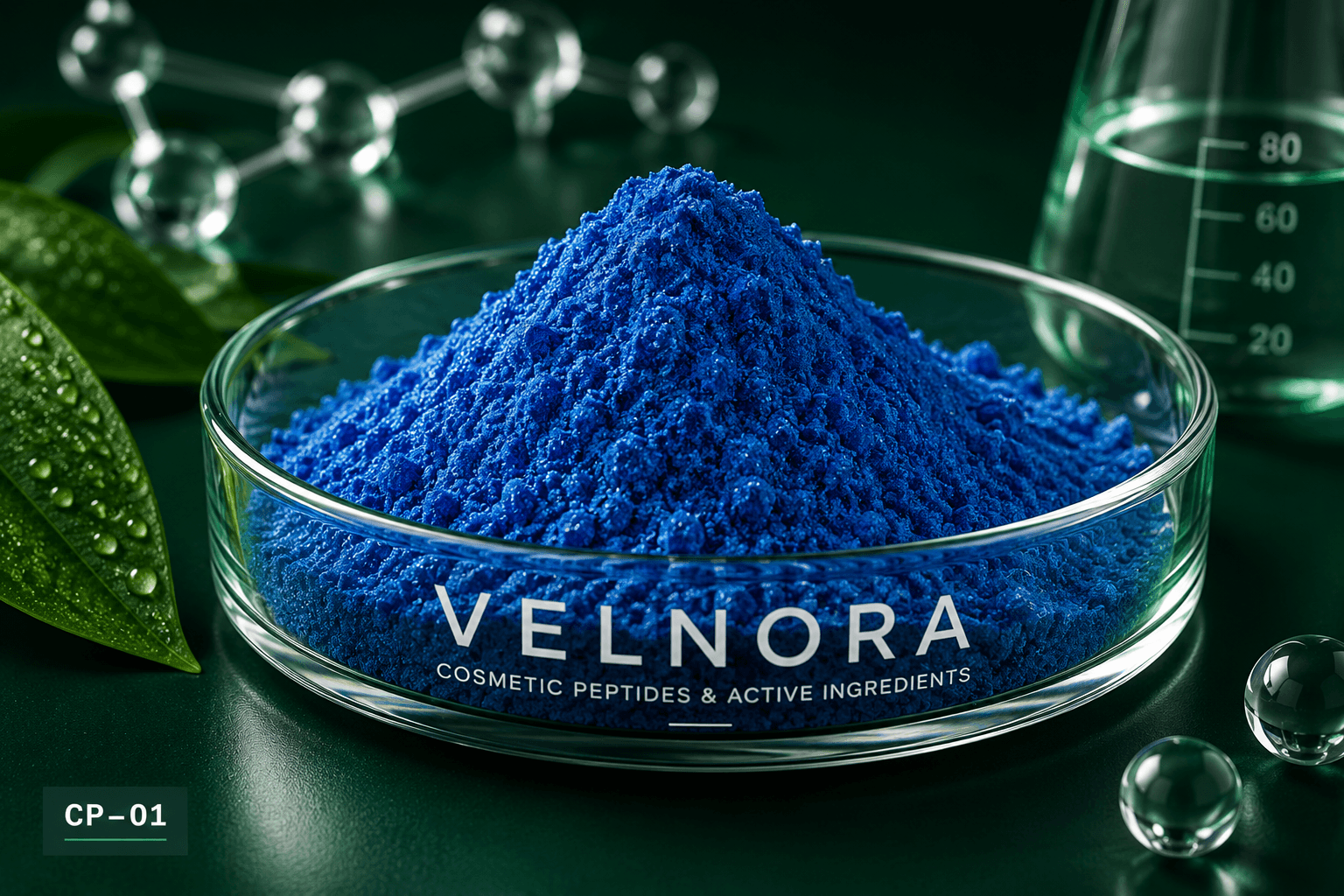
Copper Tripeptide-1 is the INCI name for a complex formed by copper and the tripeptide GHK, or glycyl-L-histidyl-L-lysine. The approved COSMIVARA reference identifies CAS 89030-95-5 and describes the offered material as a blue crystalline powder, water soluble, with a reference assay of ≥99%. Final commercial specifications remain subject to the agreed purchase specification and batch Certificate of Analysis.
The Cosmetic Ingredient Review (CIR) assessment identifies Copper Tripeptide-1 as a skin-conditioning agent. Its Expert Panel concluded that the assessed peptide ingredients, including Copper Tripeptide-1, were safe in the practices of use and concentrations described in that safety assessment. That wording is important: it is not a finding that every concentration, route, formula or use pattern is automatically safe.
GHK-Cu for skin has attracted research interest because the copper-peptide complex participates in biological mechanisms studied in cell, tissue and animal models. These studies can inform hypotheses, but they do not by themselves substantiate a consumer-facing claim for a specific cosmetic formula. Product developers still need evidence appropriate to the finished product, intended market and proposed wording.
This article addresses professional cosmetic formulation. It is not medical advice and does not position Copper Tripeptide-1 as a treatment for acne, rosacea, eczema, wounds or any other condition.
Sensitive-Skin Formulations: What Formulators Should Consider
A sensitive-skin concept benefits from a disciplined formula architecture. Start by deciding what the product must accomplish, then remove ingredients that do not contribute to that brief. Fewer fragrances, colorants, aggressive solvents and overlapping high-intensity actives can make both tolerance assessment and stability troubleshooting more interpretable.
Concentration selection should follow data for the exact commercial grade and the complete formula. “More” does not automatically mean better performance, and a raw-material assay is not a recommended finished-product use level. Formulators should screen a rational concentration range, control pH, document the order and temperature of addition, and assess whether the preservative system remains effective in the resulting matrix.
Barrier-supporting co-ingredients and an appropriate vehicle may be considered, but they do not cancel the need for testing. Patch or supervised use testing of the finished cosmetic product, designed for the intended market and claims, is more relevant than tolerance data for one isolated ingredient. Dermatological conditions fall outside ordinary cosmetic treatment positioning and should not be used to imply therapeutic suitability.
Mature-Skin and Age-Support Formulations
GHK-Cu skincare formulation is frequently explored for skin-conditioning products addressing the appearance of fine lines, surface texture and mature-looking skin. The scientific rationale includes mechanistic and preclinical research on extracellular-matrix processes. This makes Copper Tripeptide-1 an ingredient of legitimate formulation interest, but the evidence hierarchy must remain visible.
A 2026 systematic review of GHK-Cu in aesthetic medicine found 20 eligible studies: 18 were preclinical and only two were randomized controlled trials. The authors described biological rationale and some positive clinical observations, while also emphasizing methodological variability and the limited number of well-designed clinical trials. That balance does not support guaranteed collagen rebuilding, “reverse aging,” tissue-regeneration promises or a universal performance percentage.
For a mature-skin brief, formulators can define measurable cosmetic endpoints such as hydration, sensory properties, appearance of fine lines and consumer-perceived skin feel. Claims should be supported on the actual finished product. Packaging, light exposure, oxidative conditions and compatibility with other age-support actives should be considered early rather than after a formula has been finalized.
Oily and Blemish-Prone Skin Formulations
Copper Tripeptide-1 is not automatically non-comedogenic. Comedogenicity and pore-clogging perception are primarily finished-formula questions influenced by the vehicle, emollients, film formers, dose, application frequency and test population. A raw ingredient name cannot guarantee the behavior of a complete product.
For oily or blemish-prone positioning, a lightweight vehicle, restrained residue and non-occlusive sensory profile may improve product fit. Avoid unnecessary complexity: multiple exfoliating acids, strong solvents, reducing ingredients, botanical concentrates and metal-containing materials can create both stability and tolerance questions. If the broader routine includes acidic or intensive blemish-care products, directions and product sequencing should be clear without claiming that Copper Tripeptide-1 treats acne.
The finished product should be assessed for physical stability, preservation, application feel and appropriate tolerance. Any non-comedogenic claim should be based on relevant substantiation for that formula, not borrowed from the raw material.
Can Copper Tripeptide-1 Be Used in Barrier-Supporting Formulations?
It may be considered as a skin-conditioning component within a barrier-supporting cosmetic strategy. The wider formula can focus on hydration, reduced formulation complexity and complementary ingredient families such as glycerin, panthenol, Ectoin, beta-glucan, hyaluronic acid or sodium hyaluronate, and ceramides.
These families solve different formulation tasks and should not be presented as proven synergies without direct evidence for the actual combination. Glycerin and hyaluronic materials can contribute to humectant design; ceramide systems may require specialized dispersion or emulsion architecture; panthenol, beta-glucan and Ectoin bring their own grade, solubility and processing considerations. Each addition can also change ionic load, viscosity, preservation or sensory properties.
A good barrier-supporting prototype is coherent rather than crowded. Set the target texture and application profile, add ingredients in a controlled sequence, and compare the Copper Tripeptide-1 version with an appropriate control. This makes it easier to distinguish a useful formula change from color, rheology or preservation noise.
Copper Tripeptide-1 + Ectoin: A Formulation Perspective
Ectoin has broad utility in professional cosmetic development and is often considered for hydration and sensitive-skin or barrier-supporting concepts. COSMIVARA's approved Ectoin product reference describes a water-soluble crystalline powder. Copper Tripeptide-1 is also described as water soluble, but shared solubility does not prove that two ingredients will remain compatible in a finished formula.
The combination may be considered in complementary formulation strategies because the ingredients serve different product-development narratives. Formulators still need to validate dissolution order, pH, concentration, color, rheology, preservation, chemical stability and packaging. It should not be assumed that Ectoin buffers, protects or stabilizes GHK-Cu, nor that the two ingredients operate in separate skin layers in a guaranteed finished-product mechanism.
Teams planning the combination can review the Ectoin formulation guide, then design a small matrix: base control, each ingredient separately and the combination. Use the same packaging and storage conditions intended for commercialization so any effect can be attributed more reliably.
Compatibility Matters More Than Skin-Type Labels
A “skin type” label cannot resolve the chemistry of a GHK-Cu formula. Strongly acidic systems, reducing agents, chelating systems, metal-containing ingredients, high ionic loads, complex botanical extracts, preservative systems and rheology modifiers can all change the development risk. None should be converted into a universal prohibited list without evidence from the exact composition.
For example, a chelator may compete for copper; a reducing environment may alter copper chemistry; a low-pH acid system may create a different coordination and stability environment; electrolytes may reduce polymer viscosity; and a botanical extract may introduce unidentified ligands, color or trace metals. The correct professional conclusion is usually “requires compatibility testing,” not “completely destroys GHK-Cu.”
The published Copper Tripeptide-1 compatibility guide provides a deeper review of chelators, L-ascorbic acid, glutathione, pH, retinoids, niacinamide, polymers and botanical extracts. It also explains why visible color change is a warning signal rather than automatic proof of complete activity loss.
Three Common Formulation Mistakes
- Treating raw-material properties as finished-product claims. A blue, water-soluble, high-assay powder does not prove that a serum is stable, non-comedogenic, suitable for sensitive skin or clinically effective. Raw-material qualification and finished-product substantiation answer different questions.
- Assuming higher concentration means better performance. Concentration changes cost, color, ionic load, interaction risk and exposure. Select a technically and commercially justified range, then generate evidence rather than using the highest level as a shortcut.
- Ignoring pH and co-ingredient compatibility. A formula can look acceptable at time zero while coordination chemistry, oxidation, viscosity or preservation changes during storage. Define critical attributes and evaluate them over time.
These mistakes are avoidable when R&D, procurement, quality and marketing teams agree on the ingredient identity, prototype controls, claims boundary and commercial specification before scale-up.
How to Evaluate a Copper Tripeptide-1 Raw Material
Begin with identity. The name on the quotation, label, specification and batch record should align with INCI Copper Tripeptide-1 and CAS 89030-95-5. For the current COSMIVARA reference, confirm the blue crystalline appearance, water solubility and ≥99% reference assay against the offered grade. Ask how the assay is defined and which batch specification will govern the purchase.
| Identity | INCI Copper Tripeptide-1; CAS 89030-95-5 |
|---|---|
| Reference appearance | Blue crystalline powder |
| Reference assay | ≥99%; final commercial specification follows the agreed purchase specification and batch Certificate of Analysis |
| Reference solubility | Water soluble |
| Storage | Store sealed in a cool, dry place protected from light; final conditions follow the agreed commercial specification |
| Packaging | Sample and bulk packaging may be available; final configuration depends on grade and order quantity |
Documentation availability must be confirmed for the selected grade and inquiry; do not assume that every certificate, test report or regulatory document exists. A representative sample should be linked to the proposed commercial material so laboratory findings remain meaningful for purchasing.
During sample evaluation, record lot identity, dissolution method, addition temperature, pH, appearance and storage. Test the ingredient in the intended formula rather than only in water. Before scale-up, align the formulation team's technical acceptance criteria with procurement's commercial specification and the quality and documentation process. Buyers can also review the COSMIVARA resource library or contact the team with a defined grade, quantity, destination and evaluation objective.
Frequently Asked Questions
Is Copper Tripeptide-1 suitable for sensitive-skin formulations?
It may be evaluated in a sensitive-skin cosmetic concept, but the raw ingredient cannot establish finished-product suitability. Concentration, vehicle, pH, preservatives, co-ingredients, packaging and finished-formula tolerance testing all matter.
Can Copper Tripeptide-1 be used in mature-skin formulations?
Yes, formulators may evaluate it as a skin-conditioning ingredient in age-support concepts. Mechanistic and preclinical interest is broader than the modern standardized human clinical evidence, so finished-product claims should match the evidence generated for the actual formula.
Is Copper Tripeptide-1 automatically non-comedogenic?
No. Comedogenicity is primarily a property of the finished formula and its use conditions. The vehicle, emollients, film formers, dose, application pattern and target population require evaluation.
Can Copper Tripeptide-1 be formulated with Ectoin?
The combination can be considered, particularly in hydration and barrier-supporting concepts, but compatibility must be demonstrated in the complete formula using the intended grades, concentrations, process and packaging.
Can Copper Tripeptide-1 be formulated with niacinamide?
Niacinamide is not an automatic exclusion. Formulators should still test the exact grades and complete system for pH, appearance, chemical stability, rheology, preservation and packaging compatibility.
What pH should formulators consider?
There is no universal finished-product pH. A moderately acidic to near-neutral screening region may be practical, but the selected Copper Tripeptide-1 grade and every other component must guide the final target and specification.
What compatibility testing should be performed?
A risk-based plan can include time-zero controls, accelerated and real-time stability, pH, color, odor, viscosity, separation, precipitation, microbiological quality, packaging interaction and a stability-indicating chemical method where commercially justified.
What should buyers check before sourcing Copper Tripeptide-1?
Confirm INCI identity, CAS, appearance, assay basis, solubility, agreed batch specification, storage, packaging, sample representativeness and which documents are available for the selected commercial grade.
Evidence Sources and Reading Notes
The evidence hierarchy used here places authoritative cosmetic safety assessment and systematic review above mechanistic summaries. Neither source replaces finished-formula stability, safety assessment or claim substantiation.
- Cosmetic Ingredient Review. Safety Assessment of Tripeptide-1, Hexapeptide-12, Their Metal Salts and Related Ingredients as Used in Cosmetics.
- Mokhtar et al. The Regenerative Potential of GHK-Cu in Aesthetic Medicine: a systematic review. Aesthetic Surgery Journal (2026).
- Topically applied GHK as an anti-wrinkle peptide: advantages, problems and prospective. International Journal of Cosmetic Science.
Request Copper Tripeptide-1 Information from COSMIVARA
Contact COSMIVARA to request current Copper Tripeptide-1 specifications, confirm documentation availability, discuss sample options and obtain commercial supply information. Share the intended cosmetic application, required grade or specification, evaluation quantity, destination and packaging needs so the team can provide a focused B2B response.
For a preliminary sourcing question, contact COSMIVARA on WhatsApp.