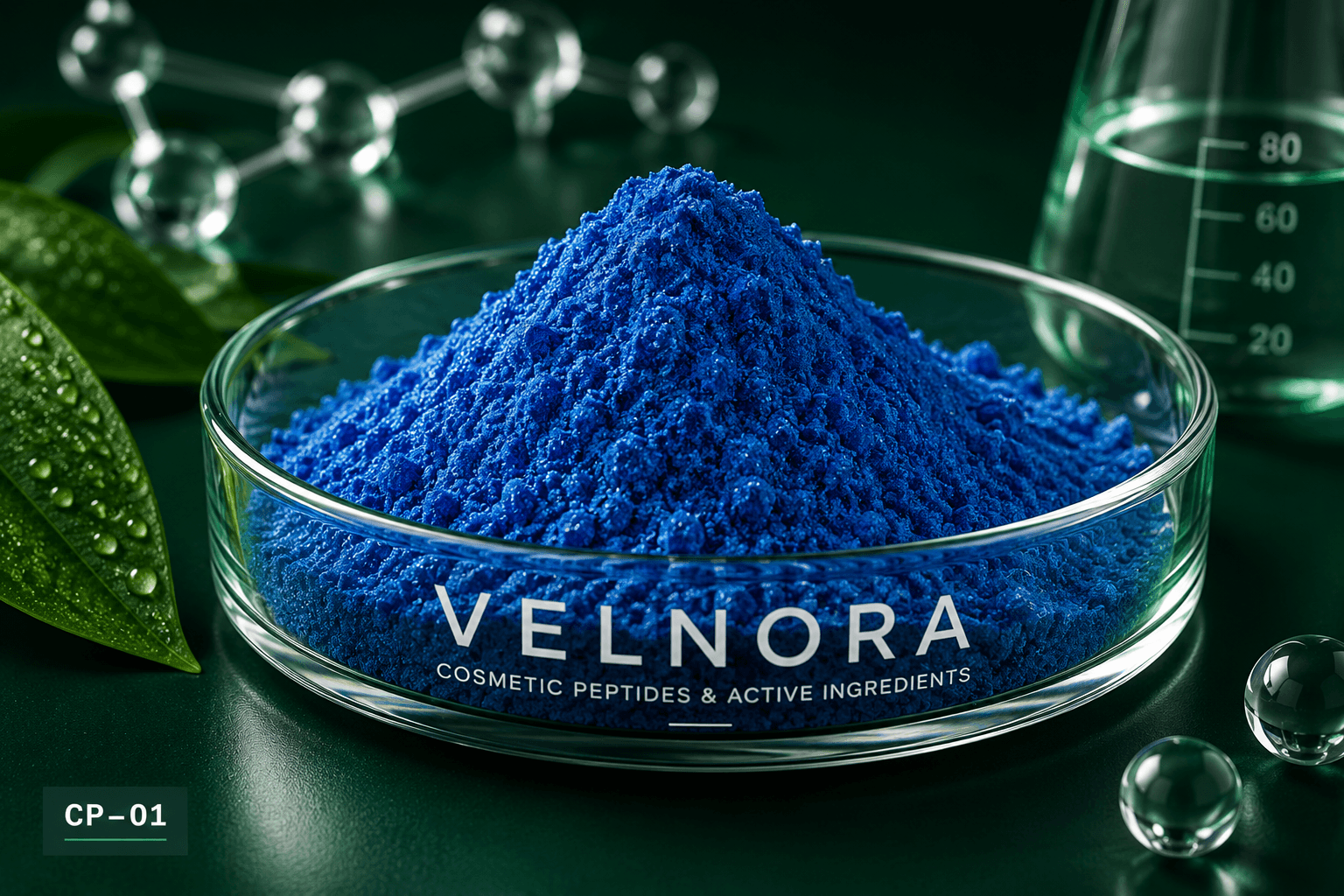
What Is Copper Tripeptide-1 (GHK-Cu) Powder?
Copper Tripeptide-1 powder is the dry raw-material form of a complex formed by copper and the tripeptide GHK, or glycyl-L-histidyl-L-lysine. Copper Tripeptide-1 is the INCI name, while GHK-Cu is the common technical identifier. The Cosmetic Ingredient Review describes the ingredient as a complex of copper and Tripeptide-1 and identifies its cosmetic function as skin conditioning.
The approved COSMIVARA reference describes a blue crystalline powder for professional cosmetic formulation and ingredient evaluation. Its color is associated with the copper complex, while its exact identity and commercial quality must be assessed through the applicable specification and batch controls. The material should not be confused with uncomplexed GHK, a generic copper salt or another copper-containing ingredient.
This distinction matters to a buyer because a name alone does not define the offered grade. Procurement teams should align the quotation, label, specification and available batch documentation around the same INCI, CAS, form and assay basis. The current Copper Tripeptide-1 product page is the source for COSMIVARA's approved reference data, while the focused Copper Tripeptide-1 information page provides a concise B2B inquiry path.
Key Specifications Buyers Should Review
A professional comparison starts with the exact commercial grade, not a keyword or price per kilogram. The following table reproduces the current approved COSMIVARA product data. Values are reference information for evaluation; the agreed purchasing specification and batch result control the commercial lot.
| Product code | CP—01 |
|---|---|
| INCI | Copper Tripeptide-1 |
| CAS | 89030-95-5 |
| Appearance | Blue crystalline powder |
| Reference assay | ≥99% |
| Solubility | Water soluble |
| Storage | Store sealed in a cool, dry place protected from light. Final storage conditions follow the agreed commercial specification. |
| Packaging | Available in sample and bulk packaging. Final packaging configuration is confirmed according to ingredient grade and order quantity. |
| Documentation status | Availability is confirmed for the selected grade and inquiry; no universal document package is promised. |
Specifications shown are reference values for product evaluation. Final commercial specifications are subject to the agreed purchase specification and batch Certificate of Analysis.
For identity, check that INCI and CAS remain consistent across commercial records. For appearance, establish a practical receiving observation without turning color into an analytical conclusion. For assay, request its definition and test method. For solubility, distinguish a raw-material statement from behavior in the intended formula. For storage and packaging, use the current supplier instruction and the configuration offered for the actual order.
What Does Purity Mean When Buying GHK-Cu?
A headline Copper Tripeptide-1 purity value is useful only when the buyer understands what was measured. The current COSMIVARA reference assay is ≥99%, but comparison still requires the applicable analytical method, reporting basis and batch-specific result. Two offers displaying the same percentage may use different test procedures, integration rules, reference materials or definitions of the target substance.
Ask whether the documentation distinguishes peptide identity, copper-complex identity and quantitative assay. Water or moisture, residual materials and other grade-specific controls may also matter when they are included in the agreed specification. A total copper result, a peptide assay and a test directed at the intact copper complex do not necessarily answer the same quality question.
Higher stated purity does not automatically guarantee easier processing or better finished-product performance. Formulation outcome also depends on identity, moisture exposure, weighing accuracy, dissolution, pH, co-ingredients, preservation, process and package. Buyers should compare the complete specification and method rather than rank materials by one large number. COSMIVARA does not publish a chromatogram or an unverified method claim in this guide.
Appearance and Color: What Can Blue Powder Tell You?
GHK-Cu commonly has a characteristic blue appearance related to its copper coordination environment. For incoming review, color, uniformity and the presence of visible foreign matter can be documented under controlled lighting and compared with the applicable appearance specification. Photography, container type and powder depth can influence what an observer sees, so a consistent observation method is useful.
Blue color alone does not prove purity, identity, potency, stability or authenticity. A material can look broadly similar while differing in composition, and a modest shade difference does not by itself establish that the material has changed. Visual inspection is therefore one checkpoint within a larger qualification process, not a substitute for appropriate identification and assay work.
If appearance falls outside the agreed description, quarantine the material under the buyer's quality procedure and request clarification before formulation. Avoid diagnosing the cause from a photograph alone. Batch documentation, retain samples and suitable testing provide a stronger basis for a decision.
Copper Tripeptide-1 Solubility and Formulation Handling
The approved COSMIVARA data identifies the powder as water soluble. That statement supports evaluation in an aqueous phase or a separately prepared aqueous concentrate, but it does not provide a universal loading, dissolution time or process temperature. Actual handling depends on concentration, water quality, pH, mixing, order of addition and the other dissolved materials.
Begin bench work with controlled weighing and a documented addition sequence. Confirm that the powder has dispersed and dissolved rather than relying only on the disappearance of visible particles. When preparing a concentrate, record the grade, concentration, batch temperature, mixing time and appearance so the procedure can be repeated. Limit avoidable contamination and return the raw-material container to its specified storage condition after dispensing.
Raw-material solubility is not the same as finished-formulation compatibility. A water-soluble ingredient can still interact with polymers, electrolytes, preservatives, colorants or other actives, and a clear time-zero sample may later change. Assess the complete product for appearance, pH, viscosity, precipitation, preservation, chemical stability where justified and packaging compatibility.
pH and Compatibility Considerations
GHK-Cu is a coordination complex, so pH and the surrounding chemical environment deserve deliberate review. Published solution studies show that copper coordination changes with protonation conditions, while a preformulation study reported different behavior under basic, oxidative and acidic stress conditions. These findings provide risk context; they do not create one universal pH specification for every cosmetic formula.
Chelating systems, strongly reducing ingredients, ionic materials, other metal-containing ingredients and complex botanical mixtures can change the formulation environment. Their effect depends on grade, concentration, ratios, pH, processing and the rest of the matrix. Use language such as “requires compatibility testing” instead of treating an ingredient name as proof of complete incompatibility.
For a more detailed development framework, review the GHK-Cu formulation compatibility guide. Teams considering skin-type positioning can also consult the Copper Tripeptide-1 skin and formulation guide. Both resources reinforce that a finished-formula test plan is more informative than a universal mix-or-avoid list.
Storage and Packaging Considerations
The current COSMIVARA direction is to store the material sealed in a cool, dry place protected from light, with final conditions following the agreed commercial specification. This guide does not add a temperature range or shelf life that is absent from the approved product data. Buyers should obtain the current instruction for the selected grade and ensure receiving, sampling and warehouse procedures follow it.
During use, minimize unnecessary moisture exposure and contamination. Open the container in a controlled area, use clean tools, limit open time and close it promptly. Preserve the supplier lot and internal batch identifiers through dispensing. Retain the applicable specification and batch documentation with the material record so laboratory observations can be traced to the exact lot.
COSMIVARA states that sample and bulk packaging are available, with final configuration confirmed according to grade and order quantity. It does not publish a fixed net weight for this product in the current database. Ask about inner container, closure, outer protection, labeling and available pack sizes before finalizing the order. The Quality and Supply Approach page explains the broader specification and supply-review process.
Powder vs Premixed Solution: What Should B2B Buyers Compare?
Format changes both formulation work and commercial evaluation. The current COSMIVARA product reference is a powder; it does not confirm that COSMIVARA offers a premixed solution grade. Buyers comparing external formats should assess the complete composition rather than assume one is universally superior.
| Comparison point | Powder | Premixed solution |
|---|---|---|
| Concentration control | Formulator selects the working concentration and dilution. | Active concentration is predefined and must be verified. |
| Process | Requires accurate weighing and a controlled dissolution step. | May simplify measuring, subject to mixing and compatibility. |
| Composition review | Focus on raw-material identity, assay and handling. | Also review carrier, solvent and any preservative system. |
| Logistics | Assess moisture control, dispensing and powder containment. | Assess liquid pack integrity, carrier stability and transport conditions. |
| Formulation flexibility | Offers flexibility but places more preparation control with the formulator. | Offers convenience but limits concentration and carrier choices. |
A fair commercial comparison should normalize the active amount, usable concentration, pack size, process requirements, waste and documentation. The lowest unit price can be misleading if the offers represent different concentrations or grades.
Sample Evaluation Before Commercial Purchasing
A sample program should answer defined procurement and formulation questions. A practical sequence is:
- Review the current specification. Confirm identity, form, assay basis, appearance, solubility, storage and documentation status.
- Request sample availability. Share the intended evaluation, quantity and destination; availability is confirmed case by case.
- Define the intended formulation. Record product format, target use, relevant pH region and important co-ingredients.
- Perform incoming evaluation. Apply the buyer's approved checks and retain traceability to the sample lot.
- Conduct compatibility and stability work. Evaluate the intended concentration, process, complete formula and package.
- Confirm packaging and commercial quantity. Align pack configuration with handling, scale and forecast demand.
- Request quotation and lead-time information. Include destination and purchasing requirements so the response is commercially useful.
A positive bench result supports the next decision; it does not eliminate the need to compare the commercial lot with the agreed specification. Buyers can use the sample-request route with Copper Tripeptide-1 preselected to provide the necessary context.
Questions to Ask a Copper Tripeptide-1 Supplier
A concise buyer checklist keeps technical and commercial comparisons aligned:
- What current INCI and CAS identity applies to the offered grade?
- What assay or purity specification applies, and what analytical method is used?
- How are peptide identity and copper-complex identity addressed?
- What appearance description is controlled for the grade?
- What solubility and formulation-handling information is available?
- What storage conditions apply to the offered material?
- Which sample and commercial packaging options can be confirmed?
- What documentation is available for this specific grade and lot?
- Can sample availability be checked for the intended evaluation and destination?
- Which commercial quantities are currently supported?
- What lead time and delivery terms apply to the buyer's destination?
COSMIVARA invites these questions but does not use this article to guarantee an unavailable pack, document or sample. For an early-stage discussion, use the Contact page; for a defined purchasing requirement, use the Copper Tripeptide-1 RFQ.
Common B2B Sourcing Mistakes
- Buying only on price per kilogram: identity, active basis, analytical method, pack configuration and usable quantity may differ.
- Comparing different grades as if they were identical: powder and solution offers, or different complex definitions, require normalization.
- Assuming every “99%” means the same thing: ask what is measured, how it is measured and how the batch result is reported.
- Ignoring the analytical method: a number without a defined method has limited value in supplier comparison.
- Ignoring storage and packaging: unsuitable dispensing or moisture control can undermine otherwise acceptable material.
- Skipping sample and formulation evaluation: raw-material data does not establish performance in the buyer's complete formula.
- Treating marketing language as specification data: purchasing controls should rely on agreed, reviewable information.
- Failing to verify batch documentation: retain traceability between the ordered grade, received lot and formulation work.
Frequently Asked Questions
What is Copper Tripeptide-1 powder?
Copper Tripeptide-1 is the INCI name for a copper complex of the tripeptide GHK. The current COSMIVARA reference is a blue crystalline, water-soluble powder intended for professional cosmetic ingredient evaluation and formulation.
What color is GHK-Cu powder?
The current COSMIVARA reference describes a blue crystalline powder. Color is a useful receiving observation, but it cannot independently confirm identity, purity, stability or authenticity.
Is Copper Tripeptide-1 water soluble?
The approved COSMIVARA product data lists the powder as water soluble. Formulators should still verify dissolution and finished-formula compatibility under their actual concentration, process, pH and ingredient system.
What purity should buyers compare?
The COSMIVARA reference assay is at least 99%. Buyers should compare the assay definition, identity controls, analytical method and batch result rather than treating a headline percentage from different suppliers as directly equivalent.
How should GHK-Cu powder be stored?
The current reference direction is to store it sealed in a cool, dry place protected from light. Final conditions must follow the agreed commercial specification for the selected grade and lot.
Is powder better than a premixed solution?
Neither format is universally superior. Powder offers concentration flexibility and formulation control but adds weighing and dissolution steps. A premixed solution can simplify measuring, while its active concentration, carrier and preservation system require review.
What should buyers request before placing a bulk order?
Request the current specification, batch-relevant documentation status, packaging options, storage guidance, commercial quantity, destination lead time and quotation terms for the exact grade under review.
Can formulators request samples before commercial sourcing?
A sample may be requested for evaluation, but availability is confirmed case by case according to grade, intended evaluation and destination. A sample result should be connected to the later commercial specification and lot controls.
References and Technical Context
The following sources support general ingredient identity, cosmetic function, coordination chemistry and formulation-risk context. They do not replace the current COSMIVARA commercial specification or establish untested finished-product claims.
- Cosmetic Ingredient Review. Safety assessment covering Copper Tripeptide-1 and related cosmetic peptide ingredients.
- Freedman et al. Structure of the Glycyl-L-histidyl-L-lysine–copper(II) complex in solution. Biochemistry (1982).
- Badenhorst et al. Physicochemical characterization of GHK-Cu: a preformulation study for dermal delivery. Pharmaceutical Development and Technology.
- European Commission. CosIng cosmetic ingredient database information and regulatory-use notice.
For portfolio context, see COSMIVARA cosmetic active ingredients and return to the Resources library for current sourcing and formulation guides.
Request Copper Tripeptide-1 Information from COSMIVARA
Contact COSMIVARA to request current Copper Tripeptide-1 specifications, documentation availability, sample options, packaging information and commercial quotation details. Availability and final terms are confirmed for each inquiry.
For a preliminary sourcing question, contact COSMIVARA on WhatsApp.